
What if the questions you ask a child could shape how they communicate for life? In Speech Therapy in Brooklyn, NY, the right questions do more than fill silence, they unlock comprehension, confidence, and progress. But why do some questions work better than others? The answer reveals a powerful approach that can transform how children learn to express themselves.
Contact Speech Therapy in Brooklyn, NY now.
TL;DR:
Questions are a powerful tool in speech therapy because they actively engage children in thinking, speaking, and comprehension. They support vocabulary growth, critical thinking, and more complex language use while improving comprehension and conversation skills. Through interactive dialogue, questions also strengthen social communication, helping children build confidence and communicate more effectively.
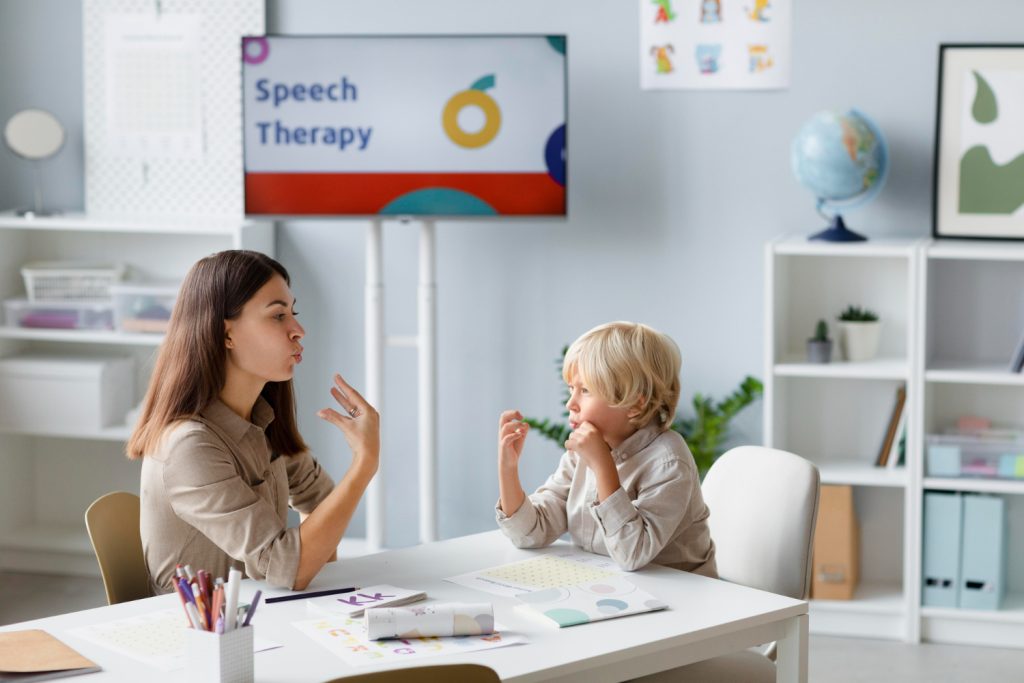
How do Questions Support Language Development?
Questions play a fundamental role in language development by actively engaging learners in thinking, speaking, and comprehension. Instead of passively receiving information, individuals become active participants when they ask or respond to questions. Research indicates that questions act as a learning mechanism, helping learners seek missing information, clarify ideas, and refine their comprehension.
Studies in developmental psychology show that children frequently ask information-seeking questions, which directly influence how they learn and organize knowledge. This process supports not only vocabulary and concept acquisition but also the development of thinking and memory. Additionally, questions create opportunities for interaction, which is essential for language growth. Through dialogue, language supports both communication and cognitive development simultaneously.
Building Critical Thinking and Reasoning Skills
Questions play an essential role in developing critical thinking by encouraging learners to go beyond memorization and actively engage with information. When learners are prompted to explain, predict, or justify their answers, they must analyze ideas, connect concepts, and organize their thoughts in a meaningful way.
- Encourage deeper thinking through prompts like “why,” “how,” and predictions
- Support connections between new information and existing knowledge
- Promote logical reasoning and structured responses
- Influence how learners categorize and process information
- Strengthen memory organization, even without immediate answers
This ongoing interaction between language and thought helps learners build stronger reasoning skills while also improving how they express their ideas.
Expanding Vocabulary Through Explanations
Questions naturally create opportunities for learners to explain ideas, and these explanations are essential for developing and strengthening vocabulary. When learners are encouraged to describe or define concepts, they actively use language in a more intentional and meaningful way.
| Element | Role in Language Development | Outcome |
| Explanations | Encourage use of new and existing words | Improved vocabulary comprehension |
| Interactive exchanges | Combine questions and responses | Better word retention |
| Elaboration | Expands on ideas and meanings | Deeper language comprehension |
| Open-ended questions | Promote varied language use | Richer and more diverse vocabulary |
These types of interactions expose learners to richer language input and give them repeated opportunities to practice and refine their vocabulary in context.
Encouraging Longer and More Complex Sentences
Questions, especially open-ended ones, play an important role in helping learners expand their verbal responses and develop more advanced language structures. Instead of relying on short or simple answers, learners are encouraged to express ideas in greater detail and connect multiple thoughts.
- Move from one-word or yes/no answers to extended responses
- Encourage combining multiple ideas within a single sentence
- Support progression from simple to more complex sentence structures
- Reinforce grammar, syntax, and expressive language skills
Over time, this repeated practice helps learners become more confident in organizing their thoughts and expressing them clearly through increasingly complex language.
Strengthening Comprehension and Conversation Skills
Questions are essential for strengthening both comprehension and conversational abilities because they require learners to actively process and respond to information. Rather than passively listening, learners must interpret meaning, organize their thoughts, and communicate an appropriate response.
| Skill Area | How Questions Help | Result |
| Comprehension | Require processing and interpreting information | Stronger comprehension of content |
| Listening skills | Encourage attention to details before responding | Improved information retention |
| Conversation structure | Guide turn-taking and responses | More organized interactions |
| Engagement | Promote active participation | Deeper learning and communication |
This active participation helps learners build stronger comprehension while also developing the skills needed to engage in effective and meaningful conversations.
Supporting Social Communication and Interaction
Questions are essential for building social communication skills and maintaining meaningful interactions. They help initiate conversations, sustain dialogue, and create opportunities for learners to practice responding appropriately in different situations.
Research shows that question-based interactions promote reciprocal communication, where both participants actively contribute. This two-way exchange supports not only language development but also social interaction, as learners become more aware of how conversations function.
Additionally, engaging in conversations driven by questions allows learners to adapt their language to different contexts. This flexibility strengthens communicative competence and helps build confidence in social interactions.
Key Takeaways.
- Questions actively drive language development
Questions turn learners into active participants by engaging them in thinking, speaking, and comprehension. They help individuals seek information, clarify ideas, and refine comprehension. This process also supports memory, knowledge organization, and overall cognitive development. - They strengthen critical thinking and reasoning
Questions encourage analysis, prediction, and explanation rather than simple recall. Learners build connections between ideas and develop logical, structured responses. This interaction between language and thought improves both reasoning skills and expression. - Questions expand vocabulary through interaction
By prompting explanations, questions encourage the use of new and existing words. Interactive exchanges and elaboration improve word retention and comprehension. These experiences lead to richer vocabulary and more meaningful language use. - They promote more complex language structures
Open-ended questions push learners to move beyond short answers into detailed responses. This supports the development of grammar, sentence structure, and expressive skills. Over time, learners gain confidence in organizing and communicating more complex ideas. - Questions enhance comprehension, conversation, and social skills
They require active processing, improving comprehension and listening abilities. Questions structure conversations, support turn-taking, and increase engagement. They also foster social interaction, helping learners build confidence and adapt communication to different contexts.
FAQs:
What is done in speech therapy?
Speech therapy involves guided activities that use questions, conversation, and interactive tasks to improve language, comprehension, and communication skills.
What does a speech therapist do?
A speech therapist supports language development by encouraging responses, asking targeted questions, and helping individuals improve how they express and understand ideas.
What is the main role of speech therapy?
The main role is to strengthen communication by developing vocabulary, sentence structure, comprehension, and social interaction skills.
What are the signs that someone needs speech therapy?
Signs may include difficulty expressing ideas, limited vocabulary, trouble forming sentences, challenges comprehending language, or difficulty participating in conversations.
Sources.
Lazaroff, E., & Vlach, H. A. (2022). “What makes this a wug?” Relations among children’s question asking, memory, and categorization of objects. Frontiers in psychology, 13, 892298. https://doi.org/10.3389/fpsyg.2022.892298
Pu, L., Kiselev, S., & Xiao, N. (2025). Language and cognitive function in children: a narrative review of neural, behavioral, and developmental evidence. Frontiers in psychology, 16, 1666719. https://doi.org/10.3389/fpsyg.2025.1666719
You May Also Like:
When Does a Child Need Pediatric Speech Therapy?
How Much Does Urology Surgery Cost?
Can High Blood Pressure Cause Tension Headaches?
Allhealth in Coney Island Avenue
1100 Coney Island Avenue,
2nd Floor, Brooklyn, NY 11230
Phone: (718) 942-4944
Email: IDD@allhealthdtc.com
Allhealth in East 13th Street
1655 East 13th Street,
Brooklyn, NY 11229
Phone: (718) 339-6900
Email: medical@allhealthdtc.com